

- February 7, 2026
- Posted by: Zahid Chauhan
- Category: Campaigns
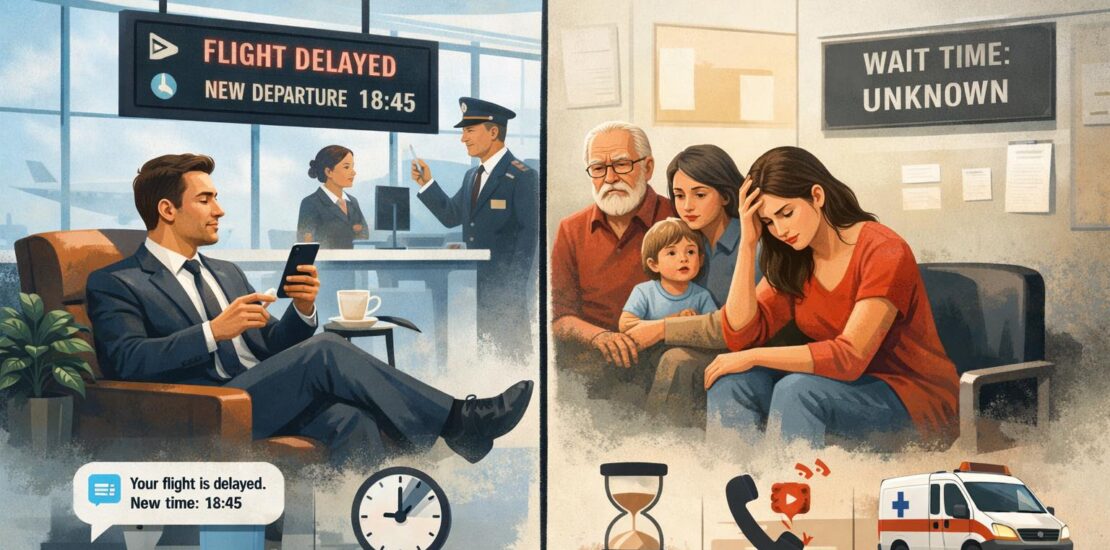
I’ve been reflecting on something that many of us experience but rarely articulate.
If you’re travelling and your flight is delayed, you’re kept informed.
The pilot makes an announcement.
Digital boards update in real time.
The lounge displays revised departure times.
You’re told the reason.
There is operational transparency.
But if you’re waiting in A&E?
Or waiting for an ambulance?
What happens then?
In most cases, very little communication. Uncertainty. Anxiety. Silence.
And this raises an important question:
In an era where the passport service can notify you when your application is received, processed, printed and dispatched why can’t more public services provide similar visibility into their processes?
Is it:
• A resource issue?
• A digital infrastructure gap?
• A cultural mindset within public services?
• Or reluctance to expose operational pressures?
The technology clearly exists. The capability exists. The expectation certainly exists.
So perhaps the real issue lies in incentives and design.
Private sector organisations compete on experience and retention. Communication is not optional, it’s strategic.
Public services, particularly in healthcare, have historically been designed around clinical risk management and compliance rather than customer experience. Transparency can feel politically risky. It may expose system strain, workforce shortages, or bottlenecks beyond frontline control.
Yet transparency builds trust.
In A&E, uncertainty often creates more distress than waiting itself. Even a simple update explaining current pressures or expected wait times can shift perception from neglect to context.
As societal expectations evolve, public service delivery must evolve with them. Operational transparency is no longer a luxury feature it is part of good governance.
Perhaps the real conversation isn’t about funding alone. It’s about mindset, leadership and system design.
Curious to hear others’ views particularly from those working across healthcare, public administration and service transformation.
What do you think holds us back?